

Professional Photographs that do not look corporate
A client recently told me she had found me after searching for a website photographer for her small business. One of the things she specifically wanted was photography that didn’t feel too corporate.
It struck me because this describes so many of the business owners I photograph.
They want to look professional, confident and established, but they don’t want photographs that feel stiff or overly formal. They want potential clients to see the personality behind the business as well as the expertise.
For a small or founder-led business, that distinction matters. Your website isn’t representing a large, anonymous organisation. Very often, you are a significant part of the brand.
So how do you create professional website photography that builds credibility without losing the warmth, individuality and personality that make your business different?
Why small businesses need a different kind of website photography
When someone lands on the website of a large company, they may be primarily interested in its products, services or reputation.
With a small or founder-led business, the relationship can be much more personal.
Perhaps you’re a consultant, coach, designer, therapist, creative professional or independent business owner. Your clients may work directly with you, and they are forming an impression of the person delivering it.
Do you seem knowledgeable? Confident? Approachable? Are you someone they can imagine working with?
Good small business branding photography helps answer some of those questions before you’ve even spoken.
This is why simply having a technically good headshot isn’t always enough. Your website photographs have an opportunity to communicate much more about you and your business.
What does non-corporate business photography actually look like?
There’s an important distinction here.
Non-corporate doesn’t mean unprofessional.
It doesn’t necessarily mean very casual clothing, candid photographs or sitting in a coffee shop with a laptop.
You can have beautifully lit, carefully composed and deliberately posed photographs that still feel warm, relaxed and individual.
The difference is that the photography is created around your business and personality, rather than trying to fit you into a standard corporate formula.
For one person, that might mean a polished studio portrait with strong lighting and confident styling. For another, it could be a softer portrait in their working environment. A creative founder might want colour and personality, while a consultant might need something more understated and authoritative.
The aim isn’t to avoid looking professional. It’s to decide what professional should look like for you.
What photographs does a small business website actually need?
This is something worth considering before the photoshoot rather than afterwards.
A website rarely needs just one good photograph.
Your homepage might need a strong hero image that immediately introduces you and your brand. Your About page may benefit from a closer, more personal portrait. Your service pages might need images of you working, interacting or demonstrating what you do.
Depending on your business, your website photography can potentially include:
- a strong hero or homepage portrait
- approachable About page photographs
- environmental portraits
- images of you working
- photographs showing your service or process
- detail images
- team photographs
- horizontal images with space for website text
- vertical portraits for mobile layouts and social media
- a variety of expressions, crops and outfits
The result should be a cohesive library of branding images, rather than one photograph being repeatedly used across every page.
And if planned well, the same photography can usually work far beyond your website – for LinkedIn, newsletters, PR, speaking engagements, marketing materials and social media.
Your photographs need to work with your website
A beautiful portrait isn’t automatically a good website photograph.
This is something I consider when planning branding photography with my clients.
A tightly cropped portrait may look fantastic on LinkedIn but be difficult to use as a homepage banner. Your web designer might need room beside you for a headline or call-to-action button. Certain pages may need landscape photographs, while others work better with vertical images.
We also need to think about backgrounds, colour, visual consistency and how the photographs will sit alongside the rest of your branding.
Sometimes that means deliberately leaving negative space around the subject. Sometimes it means photographing the same setup in several orientations. And sometimes it means creating wider compositions that allow your web designer flexibility when the website is viewed on different screen sizes.
Thinking about where the photographs are actually going to be used can make a significant difference to the usefulness of the final image collection.
Professional doesn’t have to mean corporate
For me, professionalism in a photograph comes from many small details working together.
Good lighting. A considered outfit. Confident posture. A flattering camera angle. An expression that suits the message. A clean composition. Attention to hands, shoulders and body language.
None of those things requires a photograph to look corporate.
In fact, one of the advantages of branding photography for a small business is that we have much more freedom to decide how you want to be perceived.
You might want your photographs to feel creative and energetic. Calm and reassuring. Sophisticated and authoritative. Warm and approachable. Or perhaps a mixture of several of these qualities.
Your photographs should support the impression you want clients to have when they encounter your business.
Natural photographs don’t mean you’re left to pose yourself
This is particularly important if the words “branding photoshoot” immediately make you wonder what you’re supposed to do in front of the camera.
You don’t need to know how to pose.
Some of the photographs that look the most natural and effortless actually involve quite a lot of direction.
Small adjustments to posture, the position of your hands, where you’re looking or how your weight is distributed can completely change how confident and relaxed you appear.
During a branding photoshoot, I guide you through those details.
Sometimes I’ll create movement rather than asking you to hold a pose. At other times, I’ll make very specific adjustments. We can work through different expressions too, from a warm smile to something quieter or more authoritative.
The aim isn’t for every photograph to look “posed”. It’s to give you enough guidance that you can relax and concentrate on being yourself rather than worrying about what to do with your hands.
Studio, workplace or location – which is right for your business?
There’s no single answer.
If your working environment is an important part of your business, photographing you there can help tell the story of what you do.
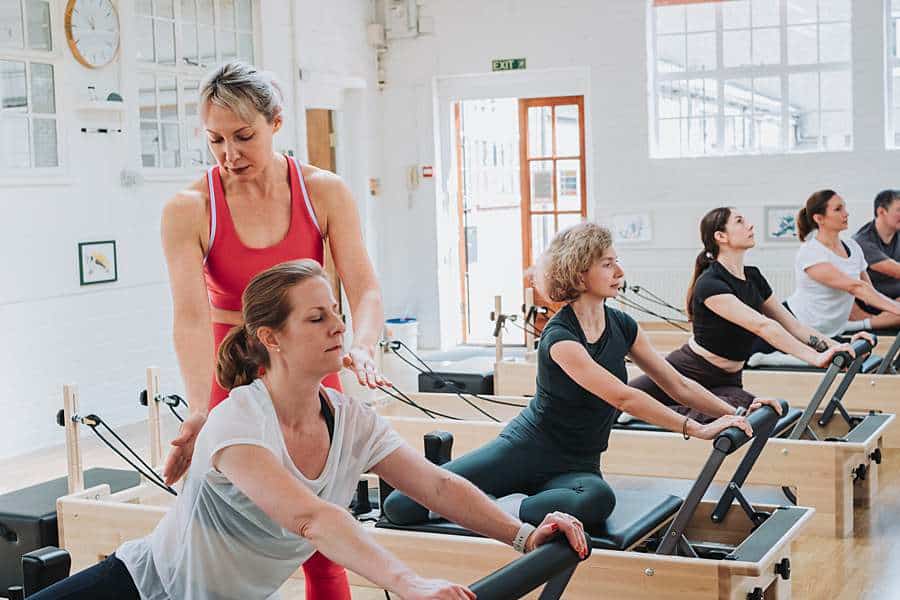
For my branding shoot with Studio Reforma Pilates, for example, the physical environment was integral to the brand. The light-filled reformer studio, equipment and interaction between instructors were all part of the story, so the photography needed to capture the space as well as the people within it.
But not every business has a photogenic workplace – and many small businesses don’t have a conventional workplace at all.
Studio photography can give us much more control over lighting, backgrounds and styling, while different outfits, props and setups can create considerable variety within one session.
Location photography is another option, particularly when the surroundings help reinforce the personality or positioning of your brand.
The right choice depends on what you do, what you want your photographs to communicate and where the images will ultimately be used.
Planning your website photography around your brand
Before photographing a personal branding client, I want to understand more than what they do.
Who are your clients? How do you want them to perceive you? What does your existing website look like? Are there particular colours within your branding? Do you want to appear more approachable, more authoritative, more creative – or perhaps all three in different photographs?
We can then plan outfits, backgrounds, lighting, props and the types of images we need.
A useful branding image collection should have variety. Some photographs can be strong and direct. Others can be warmer and more conversational. You may need close portraits as well as wider compositions. Some images might show you looking at the camera, while others can show you working or interacting naturally.
All of them should still feel like they belong to the same business. There should be a sense of consistency and coherence across images on your website. There is no confusion who the client will be working with and what they should expect.
Is website photography the same as personal branding photography?
There is a lot of overlap, but they’re not quite the same thing.
Website photography describes the purpose of the images. We’re specifically thinking about what your website needs and how photographs will work within its design.
Personal branding photography goes somewhat wider.
A personal branding session can create an image library for your website, but also for LinkedIn, press features, presentations, newsletters, social media, speaking engagements and ongoing marketing.
For many small and founder-led businesses, it makes sense to consider both at the same time.
Rather than commissioning a photograph for your About page and then discovering six months later that you need something completely different for a magazine article, LinkedIn profile or presentation, we can create a versatile collection from the outset.
Further reading: What is Branding Photography and Why is it Important
Website photography in practice: Case studies of four different businesses
There isn’t one formula for successful website photography. The photographs need to make sense for the people behind the business, the clients they want to attract and the message the website is trying to communicate. These four shoots are good examples of how differently that can work.
Studio Reforma: showing the experience working with the founder / pilate instructor in the pilate studio
For Studio Reforma Pilates, the photography needed to communicate more than what the studio looked like or the exercises being taught. It needed to give potential clients a sense of what it would feel like to take a class with founder Julia. Her teaching is attentive and hands-on, with a strong focus on alignment, individual correction and helping clients perform each movement well. We captured Julia watching closely, demonstrating movements and making adjustments as her clients worked on the reformers. These moments show the interaction between instructor and client rather than simply documenting a Pilates class. The result is a set of photographs that helps someone visiting the website imagine the experience before they have booked: personal attention, expert guidance and an instructor who is genuinely engaged in how you move and progress.
LVL London: expertise with warmth
LVL London is a boutique female-led consultancy founded by three sisters, bringing together more than 40 years of senior leadership experience. Their website therefore needed to communicate considerable professional credibility without making the founders feel remote or overly corporate. The individual portraits of Lori, Victoria and Louise towards the bottom of the homepage do exactly that: each woman looks polished and confident, but also warm and welcoming. Their personalities remain visible within a consistent visual style, helping potential clients see the experienced professionals they will actually be working with.

Stream Consulting: ready for a conversation
For business consultant Roland Hesz of Stream Consulting, the leading message on the website is very personal: “I help business owners balance their work-life.” His approach centres on practical, collaborative relationships and clear, human conversations rather than corporate jargon. His hero photograph supports that message immediately. Sitting comfortably with a cup of coffee, Roland looks less like someone about to deliver a formal corporate presentation and more like someone ready to sit down and have a useful conversation. It’s relaxed, but still professional, and gives the visitor a sense of what working with him might actually feel like.
The other pages build on that first impression. Rather than repeating the same portrait, the images show Roland in conversation with different people: listening, discussing ideas and working through things together. They sit naturally alongside the About, Services and Contact content, while giving the website more visual variety. Together, the photographs reinforce the idea that his consultancy is personal, practical and collaborative, and help visitors picture what working with Roland might actually be like.

Nassia for Nutrition: building trust through personal branding
For Nassia for Nutrition, the relationship between practitioner and client is central to the service. As a nutritional therapist supporting women with their health and wellbeing, creating a warm and reassuring first impression is particularly important. Nassia’s smiling hero portrait immediately feels professional and approachable, while a second, more relaxed portrait in the About section reinforces that sense of warmth and personal connection. Together, the images create familiarity and help prospective clients get a sense of the person they will actually be working with before making that first discovery call.

Dipii Stark: making the product the hero
For Dipii Stark London, a British-designed luxury loungewear brand, the emphasis shifts from the person behind the business to the products themselves. The collections include premium silk pyjamas, camisole sets, kimonos, kaftans and accessories. The photography has an important job to do: it needs to communicate the quality and desirability of the garments before a customer has the opportunity to see or touch them in person. The pieces are photographed stylishly on models, allowing the colour, print, drape and luxurious feel of the silk to become part of the visual experience of the website. It is a very different type of small business photography, but the principle is the same: rather than applying a generic commercial look, the photography should reflect the positioning of the individual brand. For a premium product business, that means creating images that don’t simply document what is being sold, but help the customer understand how it should look and feel to own it.

Website photography that still feels like you
Your business doesn’t have to look bigger or more corporate in order to look credible.
For many small businesses, the opposite is true.
The ability to see the person behind the company can be one of the reasons a potential client chooses you over a larger competitor.
Professional website photography should help you make that introduction with confidence. It should show your expertise and give your business a polished, consistent visual identity – while still allowing some personality to come through.
Because ultimately, the aim isn’t to make you look like somebody’s idea of a businessperson.
It’s to make you look like you, at your professional best.
Are you planning a new website or refreshing an existing one?
If you would like to understand how your website photography can fit in and maximise your business potential, I would love to hear from you.
Explore my Personal Branding Photography sessions in London, or get in touch to discuss the images your business needs.


